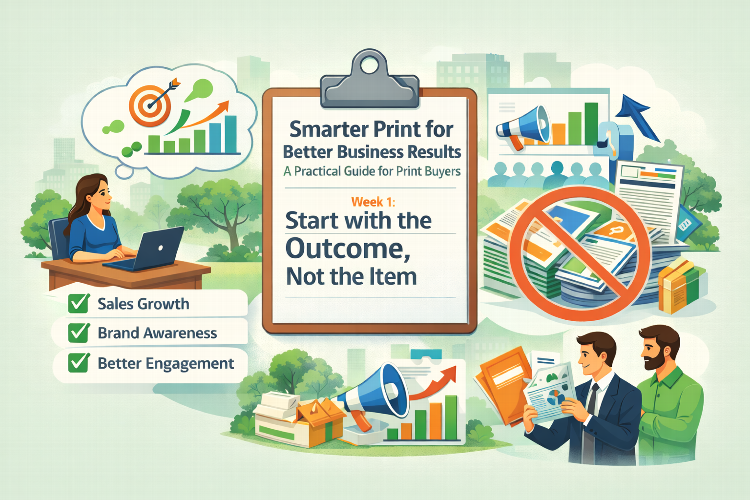
Start With the Outcome, Not the Item
How to Brief Print That Actually Drives Sales
If you're responsible for buying print for advertising or sales, chances are the brief starts with something like:
“We need 5,000 brochures.”
“We need a leaflet for this campaign.”
“We need some POS for the event.”
It's completely understandable — but it's also where many print projects quietly lose effectiveness, waste budget, and miss their commercial potential.
Better print doesn't start with what you're buying.
It starts with what you're trying to achieve.
This guide is about how to brief print in a way that supports sales, improves results, and avoids unnecessary cost and waste.
Print Is a Sales Tool, Not a Product
Print is often treated like a product to be purchased rather than a tool to solve a problem.
But print is rarely the goal.
It's a means to an outcome, such as:
- Generating enquiries
- Supporting a sales conversation
- Increasing footfall
- Reinforcing brand credibility
- Prompting a specific action
When the outcome isn't clear, decisions about format, size, paper and quantity become guesswork — and guesswork is expensive.
The Most Common Briefing Mistake:
The biggest mistake print buyers make is over-specifying too early.
For example:
- Choosing a brochure size before knowing how it will be used
- Selecting premium finishes before understanding audience expectations
- Fixing quantities without knowing distribution realities
This often leads to:
- Overproduction
- Overspending
- Waste
Print that looks good but doesn't perform
A better brief creates flexibility — and flexibility leads to better decisions.
Before speaking to a printer or requesting a quote, take a step back and answer these five questions. They form the foundation of a commercially effective print brief.
1. Who is this for?
Be specific.
- Existing customers or new prospects?
- Decision-makers or influencers?
- Cold audience or warm leads?
Different audiences require different formats, tones and levels of detail.
2. Where will it be seen or used?
Context matters more than most buyers realise.
- Handed out at an event?
- Left behind after a sales meeting?
- Picked up in-store?
- Posted through a letterbox?
Print designed for a desk behaves very differently from print designed for a pocket or a counter.
3. What action should it prompt?
Print without a clear action is decoration. Ask yourself:
- Do we want them to visit a website?
- Speak to sales?
- Keep this for later reference?
- Trust our brand more?
The clearer the action, the clearer the design and format decisions become.
4. How long does it need to last?
Is this:
- A short campaign?
- An evergreen sales tool?
- Something that will be updated regularly?
Longevity affects:
- Paper choice
- Finishing
- Print volumes
- Cost efficiency
5. What would success look like?
You don't need complex metrics, just intent.
- Fewer but better conversations?
- Higher response rate?
- Better brand perception?
This helps avoid spending money on things that don't support the goal.
Why This Matters for Cost and Sustainability
Better briefs don't just improve results — they reduce waste.
When print is specified without clarity:
- Formats are larger than necessary.
- Paper weights are heavier than required.
- Finishes are added “just in case”.
- Quantities exceed real need
Starting with outcomes allows:
- More efficient formats
- Better-fitting paper choices
- Smarter quantities
- Lower energy and material use
Sustainability isn't something bolted on at the end — it's built into the decision-making at the start.
A Simple Outcome-Led Print Brief (Use This)
Before contacting a supplier, try capturing your brief like this:
Objective: What business or sales outcome is this supporting?
Audience: Who exactly is this for?
Context: Where and how will it be used?
Action: What should the reader do next?
Lifespan: How long does it need to remain relevant?
Constraints: Budget range, timings, brand guidelines.
Notice what's missing? No sizes. No paper. No finishes.
Those decisions should come after the purpose is clear.
What to Ask Your Print Supplier This Week
If you're already working with suppliers, try asking:
- “Is this format the most efficient way to achieve the outcome?”
- “Is there a simpler or more effective option?”
- “What are the cost and waste implications of this spec?”
- The right partners will welcome these questions.
Thats part one...part 2 to follow