
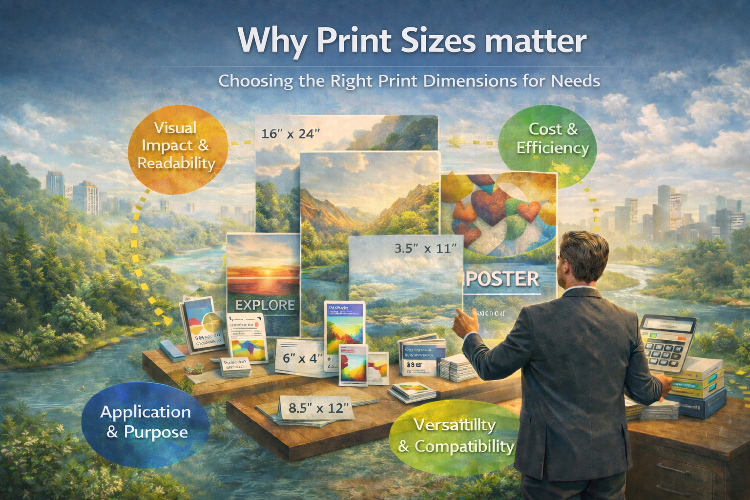
Introduction: Why Print Sizes Matter for Sustainability
At Sustainable Print Nexus, we focus on practical choices that reduce waste and improve the environmental impact of print. One of the simplest — and most overlooked — decisions is choosing the right print product size.
Using standard UK print sizes helps minimise Paper waste, Reduce energy use during production, and Avoid unnecessary reprints.
This guide explains the most common UK print product sizes and shows how selecting the right format supports more sustainable printing.
The Role of Standard Sizes in Sustainable Print
UK printers follow the ISO 216 paper size system, which is designed for efficiency. Each size scales proportionally, meaning printers can impose jobs efficiently with minimal offcuts.
Why this supports sustainability:
Less paper waste during trimming
More efficient use of printing presses
Lower material and energy consumption
Avoiding non-standard sizes is one of the easiest ways to reduce the environmental footprint of printed products.
Standard UK Paper Sizes (ISO 216)
These sizes form the foundation of most printed products in the UK.
A0 (841 × 1189 mm) – Large posters, exhibition graphics
A1 (594 × 841 mm) – Posters, flip charts
A2 (420 × 594 mm) – Posters, calendars
A3 (297 × 420 mm) – Menus, small posters
A4 (210 × 297 mm) – Letters, flyers, reports
A5 (148 × 210 mm) – Flyers, booklets
A6 (105 × 148 mm) – Postcards, handouts
Sustainability note: A4 and A5 formats typically offer the best paper efficiency across most digital and litho presses.
Flyer and Leaflet Sizes: Efficient by Design
Flyers and leaflets are often produced in large quantities, making size choice especially important.
Common UK Flyer Sizes
A6 – Small handouts, event promotions
A5 – The most common and cost-efficient flyer size
A4 – Information-heavy flyers and notices
DL (99 × 210 mm) – Ideal for mail drops and door distribution
Sustainable print tip: DL flyers are usually created by tri-folding A4 sheets, maximising paper usage and reducing waste.
Booklets, Brochures and Reports
Publications benefit from sizes that bind efficiently and use paper economically.
Standard UK Booklet Sizes
A5 booklets – Lower paper usage and lighter for distribution
A4 booklets – Reports, manuals and policy documents
Square formats (210 × 210 mm) – Creative marketing, use selectively
Sustainable print tip: Keep page counts in multiples of four to avoid blank pages and wasted sheets.
Poster Sizes and Visual Communication
Posters are designed to be seen from a distance, but bigger is not always better.
Standard UK Poster Sizes
A3 – Indoor notices and information boards
A2 – Small promotional posters
A1 – High-visibility campaigns
A0 – Large-format displays and exhibitions
Sustainability note: Choose the smallest size that achieves visibility to reduce ink and material use.
Business Stationery Sizes
Consistent stationery sizing reduces setup waste and improves compatibility with envelopes and filing systems.
Business cards: 85 × 55 mm
Compliment slips: 210 × 99 mm
Letterheads: A4 (210 × 297 mm)
Standard sizes help avoid trimming waste and simplify recycling.
Envelope Sizes and Mailing Efficiency
Matching print products to standard envelopes prevents excess folding and postage inefficiencies.
DL (110 × 220 mm) – A4 tri-fold
C6 (114 × 162 mm) – A6
C5 (162 × 229 mm) – A5
C4 (229 × 324 mm) – A4 unfolded
Sustainable print tip: Fewer folds mean less damage, fewer reprints, and lower carbon impact.
Postcards and Direct Mail Formats
A6 postcards – Most common and postage-efficient
120 × 170 mm – Larger impact with moderate material increase
DL postcards – Mailer-style communications
Choosing sizes that fit standard postal guidelines reduces transport emissions.
Large Format and Display Print
Large format printing allows flexibility, but standard sizes remain the most efficient.
Roller banners: 800 × 2000 mm or 850 × 2000 mm
Pull-up banners: 1000 × 2000 mm
Rigid boards: A1, A0, or standard custom sizes
Always confirm the visible area to avoid reprints.
Folding Formats and Material Efficiency
A4 half-fold → A5 – Menus and booklets
A4 tri-fold → DL – Leaflets
A3 half-fold → A4 – Brochures
Designing with folds in mind reduces setup errors and wasted stock.
Print-Ready Setup for Sustainable Outcomes
Preparing artwork correctly avoids waste caused by errors.
Add 3 mm bleed on all sides
Keep text 5 mm from trim edges
Use crop marks if requested
Supply files at final size plus bleed
Correct setup means fewer reprints and less material waste.
Conclusion: Making Sustainable Size Choices
Choosing standard UK print product sizes is a practical, low-effort way to support sustainable printing.
By designing to efficient formats, you reduce waste, lower costs, and improve the environmental performance of every print job.
At Sustainable Print Nexus, we encourage size choices that balance function, impact, and sustainability — starting with the right dimensions.