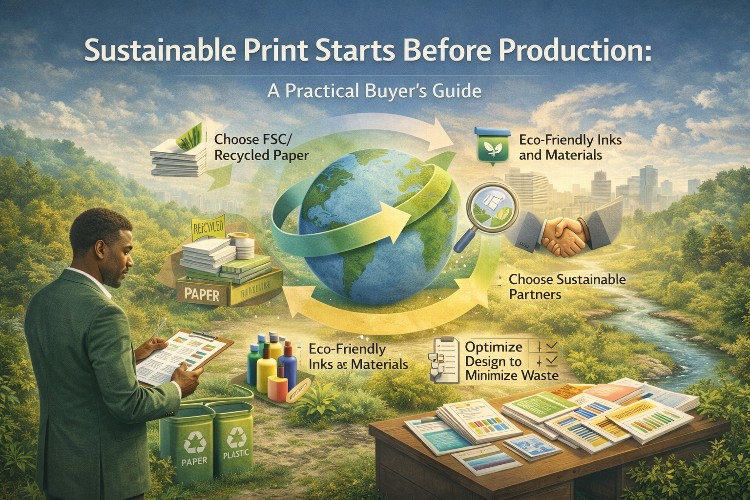
Sustainable print starts before you print
A practical guide for print buyers and marketers
Most people think sustainable print is about what happens at the end of a project — carbon reporting, recycled content, or recycling claims.
After 25 years working across print, packaging, and supply chains, I can say this with confidence:
The biggest sustainability decisions are made long before production begins.
By the time files reach a printer, most environmental impact is already locked in. That's why businesses serious about responsible print focus less on fixing problems later — and more on making better decisions earlier.
This guide explains where impact is really created, and how print buyers and marketers can influence it.
Why sustainability can't be bolted on at the end
Sustainability is often treated as a final-stage check:
“Can we choose a greener paper?”
“Can we offset the carbon?”
“Can we report this in our ESG figures?”
Those actions have value, but they don't change the fundamentals of the job.
In print, around 70–80% of environmental impact is determined before production — through scope, design, format, and supply-chain choices. If sustainability only appears at sign-off stage, it becomes a reporting exercise, not an improvement strategy.
Where print impact is really created
If you want to reduce impact, these are the decisions that matter most.
1. The brief
Every sustainable print project starts with a better brief.
- Is this item necessary?
- What is it trying to achieve?
- How long will it be used?
- How many versions are genuinely required?
Overproduction is still one of the biggest sources of waste in print — and it's driven by poor briefing, not poor printing.
2. Format and specification
Size, pagination, finishes, laminates, and coatings all affect:
- Material usage
- Recyclability
- Production efficiency
- Transport weight and emissions
Small changes in format can deliver significant reductions in waste and cost — often without affecting design or effectiveness.
3. Material choices
Sustainable print isn't about chasing logos or labels.
Paper choice affects:
- Fibre sourcing
- Weight and volume
- Compatibility with recycling systems
- Overall product lifespan
The right material is about fitness for purpose, not simply choosing the “greenest” option on paper.
4. Production methods
Digital or litho? Standard or bespoke? Local or centralised?
Production decisions influence:
- Energy use
- Make-ready waste
- Run efficiency
- Unit cost versus total impact
Designing for efficient production often delivers both sustainability and commercial benefits.
Supplier selection
A sustainable printer isn't defined by marketing claims — but by behaviour.
What matters is:
- Transparency
- Consistency
- Process control
- Traceability
- Willingness to challenge poor decisions
The right supplier reduces impact before ink hits paper.
Measuring impact isn't the same as managing it
Carbon calculators and sustainability reporting have a role — but they are rear-view mirrors.
They tell you what happened, not how to make it better next time.
True sustainable print management means influencing decisions at the point where impact is created, not simply documenting outcomes after the fact.
practical approach to sustainable print
At Sustainable Print Nexus, we help organisations embed responsibility where it actually works:
- At briefing stage
- During format and specification development
- When selecting materials and suppliers
- Before production decisions are locked in
This isn't about adding complexity. It's about asking better questions earlier.
The future of print buying
Print isn't disappearing — but poorly considered print is.
The most effective print buyers and marketers understand that:
- Sustainability improves efficiency
- Better decisions reduce waste and cost
- Responsibility starts with intent, not reporting
When sustainability is designed in from the start, everything downstream becomes simpler, more credible, and more effective.